What is a Roux-en-Y Gastric Bypass?
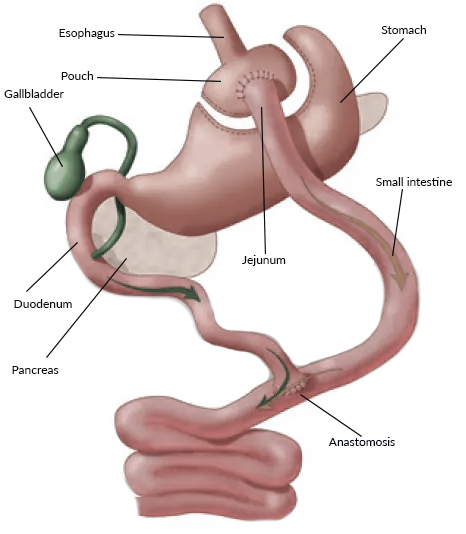
Roux-en-Y gastric bypass is the 2nd most frequently performed bariatric surgery.
It is named after the Swiss physician César Roux who was the first practitioner connecting the lower jejunum to the small intestine in the form of an Y-shaped loop back in 1907.
During this procedure a small part of the stomach is divided from the rest creating a small pouch that can contain only between 20-40 ml. An artificial sphincter is created where this pouch is anastomised with the small intestine just below the jejunum. By doing so the greater part of the stomach, the duodenum and most part of the jejunum are bypassed. The jejunum is then stitched to the small intestine a little bit further down, creating the Y-shape this bypass is named after.
The food, hence, arrives relatively undigested further down in the small intestine. This results in shorter digestion time plus a shorter digestion pathway, which leads to inferior absorption of the food, calories as nutrients. This is called malabsorption. (source: Wikipedia)
What happens precisely in the body that enhances fast and durable weight loss?
On the one hand, the reduction in stomach volume and the shorter digestive pathway lead to purely functional and mechanical changes in the utilisation of food.
A feeling of satiety is reached more quickly due to the reduced stomach volume and the food is not utilised as efficiently..
On the other hand, however, there is a much more profound physical, chemical as well as biological restructuring of the digestive system. Here are some examples without claiming to be complete:
- In the small gastric pouch less gastric acid is produced due to the smaller volume. The food passes on into the intestine staying rather pH-neutral. Important bacteria can survive. This improves the intestinal bacterial flora. (source: ScienceDirect.com)
- Due to the shorter pathway from stomach to small intestine you will find more oxygen in the lower intestine. The large intestine is normally anaerobic (free from oxygen). Anaerobic bacteria are therefore pushed back and aerotolerant bacteria such as Proteobacteria or Escherichia can multiply. The intestinal flora improves sustainably. (source: Frontiers.com: Roux en Y gastric bypass induced indicated pertubated changes in microbial communities and metabolic pathways)
- Bile juice is introduced only further down the small intestine. This leads to a changed bile juice concentration in the intestine. Bile juice functions as a natural antibiotic in the intestine: it stops and enhances the growth of certain bacterial strains. This has as consequence a new organisation of the intestinal flora. (source: Nature.com: Ideal microbial shifts after Roux-en-Y gastric bypass; aerzteblatt.de)
- Reduced food input and different composition of food influence the microbiotic environment of the intestinal mucosa. (source: Naturals Library of Health)
Immediately after the surgery you can find a massive reduction of bacteria that promote weight gain, as the surgical procedure as well as the special diet deprive the bacteria of their nutritional basis. This leads to a spontaneous increase of healthy intestinal bacteria (e.g. Akkermansia muciniphila bacteria). (source: PMC.ncbi.nlm.nih.gov National Library of Medicine PubMed Central: The impact of bariatric Surgery on Gut Microbiota Composition and Diversity: A longitudinal Analysis Using 16S rRna Sequencing)
On the long term, there is an increase in genetic and species diversity in the intestine. A study shows the increase of gut bacteria (alpha diversity) and genetic diversity within 6 to 12 months after the operation. (source: Nature.com : Gut microbiata responses to bariatric surgery)
In addition to the weight loss there is a significant reduction of comorbidities to be noted: The remission rate of diabetes type 2 lies by 62%.
Also cardiovascular risk factors reduce remarkably. Within 4 years the risk of developing heart failure is reduced by 47%, cancer mortality by 46%. The mortality rate of patients above 55 years goes down from 6,1% to 2,8%. (source: National Library of Medicine)
Surgical Procedure
The Roux-en-Y gastric bypass can be performed laparoscopically with 4-6 access points in the upper and middle abdomen. They measure max 1 cm each. This technique enhances faster recovery, reduces the risk of complications, is aesthetically more pleasing and allows a faster return to normal life and work. (source: National Library of Medicine)
Side Effects
Though there are many beneficial effects of the Roux-en-Y bypass there are also certain inconveniences and side effects.
- As mentioned before the shorter pathway of the food leads to a general malabsorption not only of calories but also of important micronutrients that are crucial for a healthy life condition. Most importantly concerned are vitamin B12, vitamin D, iron and calcium. A lack of them can lead to anaemia and osteoporosis, which is why they need to be substituted for a lifetime. (source: Alobariatrics).
- The oxygen that penetrates deeper into the intestine, though it enhances healthy bacteria growth, can, on the other hand, provoque bloating.
- Bowl movements change.
- Patients can also suffer from the so-called dumping syndrome. There are 2 kinds. The first happens 15 to 30 minutes after food intake. It is caused by the non-digested food moving rather quickly forward into the jejunom. Normally, this is prevented by the sphincter of the stomach. However, by creating an artificial sphincter at the pouch the food passes through without any barrier. In reaction to the highly concentrated food the body suddenly draws fluid from the blood to move it into the intestine. This can cause abdominal pain, nausea, dizziness and a drop in blood pressure. (source: National Institute of Health / Johns Hopkins Medicine)
- The 2nd kind of dumping syndrome occurs 1 to 3 hours after food intake, which is why it is referred to as late dumping. Especially after quite sugary meals the pancreas releases a high dose of insulin into the small intestine which has as consequence a drop in the blood sugar. This can cause either intense hunger, rembling or cold sweat. This, however, can be counteracted through appropriate dietary adjustments, whereas dietary supplements to counteract deficiency symptoms are permanently essential. Regular blood tests should be carried out for monitoring. (source: National Institute of Health)
A New Way of Life
Generally, Roux-en-Y bypass surgeries are indicated when conservative therapies have been of no lasting avail at a BMI of > or = 35kg/m2. This surgery is understood as a general reset of the system. It is important to support the body and the mind during this genetic reset to enhance lasting success. Alongside with dietary adjustments there are also adjustments in one’s life habits required. Why it is so important to check what the factors were that led to the overweight. It therefore makes sense to involve the social environment and the family as well. A new lifestyle with sufficient sleep, fitness and exercise, which bring joy and are fun, increases the chances of maintaining the reduced body weight. In order to maintain the success in the long run, it is therefore important to change lifestyle habits in the long term. Gastric bypass surgery can help to lose weight without having to starve, it changes the brain’s perception of hunger, and enhances a 70-80% loss of excess weight. (UNM Health). What is made of this reset then depends on the patient’s commitment. (source: https://www.gesundheits-lexikon.com)